The revision of ISO 14001 – Everything you need to know now!
ISO 14001: current status and outlook
Based on the results of the 2021 user survey, it was decided not to completely revise ISO 14001:2015, but to make minor adjustments as part of an amendment without introducing new customer requirements. The working group began the revision in September 2023, and the draft amendment was published in February 2025.
It is now clear that there will be a consolidated revision of the standard, albeit with only minor new requirements. The Final Draft International Standard (FDIS) of ISO 14001 was published in January 2026, and the final standard was published on April 15, 2026.
We will show you:
- What are the changes in the ISO 14001:2026,
- What impact the new features will have on companies,
- And how you can best prepare for them.
How to prepare for the ISO 14001 revision
The transition to the new ISO 14001 will be easier if you take action early on. Even though no fundamentally new standard requirements are being introduced, there are some clarifications and reinforcements in certain areas.
Our recommendations:
- Existing environmental management system: If your system is already certified, take the opportunity to conduct a gap analysis and check whether all new requirements are being met.
- New environmental management system: If you do not yet have a certified system, it is worth building on the current standard, but taking the current requirements into account as far as possible.
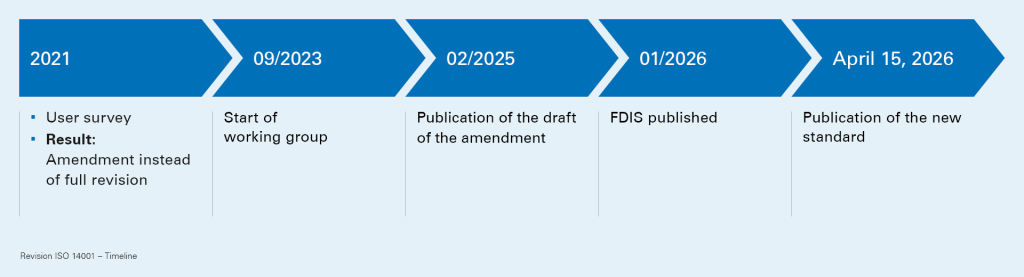
To better understand the individual steps involved in developing standards, here is a brief overview:
- Working Draft (WD): Internal working draft for rough orientation
- Committee Draft (CD): First publicly visible drafts, which are commented on within the ISO committees
- Draft International Standard (DIS): Mature draft version, which is released for public comment.
- Final Draft International Standard (FDIS): Almost final version without changes to content – final editorial adjustments
- International Standard (IS): Final publication by ISO – basis for certification
Here are the most important questions and answers for you to review.
Frequently asked questions about ISO 14001
What steps should companies take now?
A revision of the standard offers an opportunity to optimize your own environmental management system. Take advantage of this opportunity to conduct an effectiveness review or gap analysis.
For certified companies:
- Review and optimize your existing environmental management system.
- Your current system is the ideal basis for the 2026 version.
For non-certified companies:
- Don't wait until certification according to ISO 14001:2026 is possible.
- If necessary, obtain certification according to ISO 14001:2015. Incorporate the planned changes into your management system as far as possible.
A three-year transition period is likely. Reliable information on this is expected in the third quarter of 2026.


Contact