Carbon Service

Future proof your sustainable business practice
With industrial activities counting for a significant portion of the overall global carbon emissions, businesses are under increasing pressure from regulatory bodies, investors, consumers and the public to mandatorily disclosure their carbon emissions and demonstrate steady progress in moving towards carbon neutrality. Furthermore, how companies proactively predict and manage climate related environmental, social and financial risks as part of the disclosure is also intensively monitored by relevant stakeholders.
But how can you prove your commitment, if collecting and reporting high quality inventory data about greenhouse gas (GHG) emissions is such a technically complex task? The challenge applies in particular to indirect emissions generated along the value chain from supply chains to consumer use. Companies are increasingly seeking third-party verification to their carbon reporting and climate disclosure to raise confidence and identify gaps for data quality improvement.
At TÜV Rheinland, our environmental sustainability experts can support businesses with climate change and carbon disclosure work from multiple dimensions.

Corporate Carbon Footprint Verification
It requires a deep understanding of a company’s GHG emissions in order to develop an effective corporate climate change strategy. Corporate Carbon Footprint is the GHG generated from business activities of an organisation or a company, including energy use, transportation, waste generation, supply chain, consumer use and others. The GHG protocol defines three scopes:
- Scope 1: emissions are direct emissions from owned or controlled sources.
- Scope 2: emissions are produced indirect from the generation of purchased energy.
- Scope 3: emissions are all indirect emissions (not included in scope 2) that occur in the value chain of the reporting company, including both upstream and downstream emissions.
Corporate carbon footprint verification (CCF verification) is an assessment process to ensure that the reported GHG data is accurate, complete and reliable. This requires the use of appropriate measures to reduce any gaps and uncertainties in the data. In the verification process, the probability of data errors, omissions and misrepresentation will be evaluated and calculated to ensure that it remains below an acceptable threshold.
4 stages of sustainable carbon service
The international standard ISO 14064-3 “Greenhouse Gases Part 3, specification with guidance for verification and validation of greenhouse gas statements” is the basis of the verification process by our carbon verifiers. The process consists of four stages.
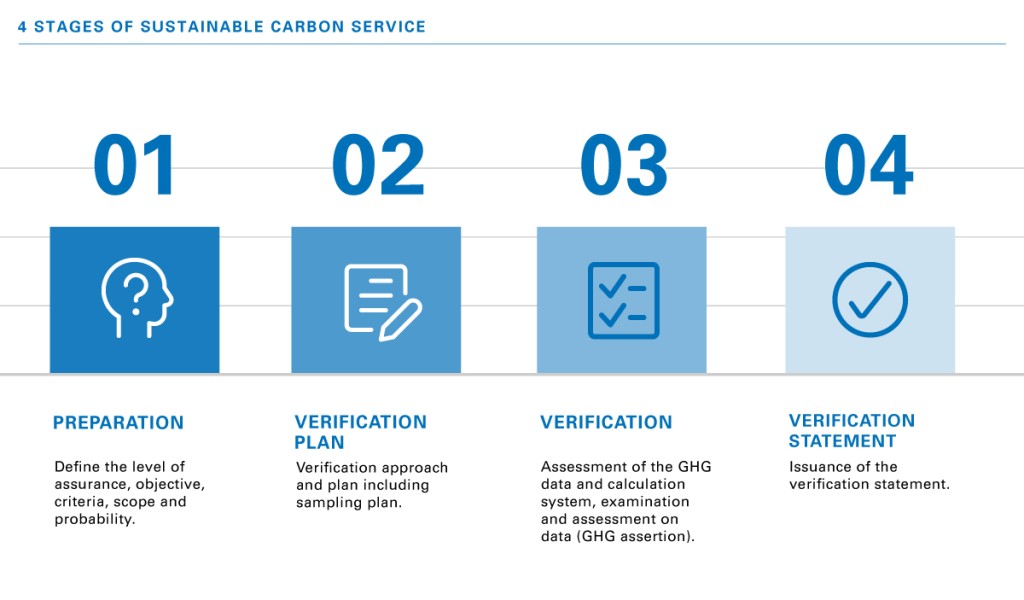
By providing independent verification to their CCF reporting, companies can demonstrate the reliability of their data. It helps them to measure and disclose carbon emissions according to the relevant standards and showcase commitment to climate protection and environmental responsibility.
Carbon Disclosure, Climate Risk Assessment, CBAM Compliance, and CCF Data Management
Our carbon expert team is well-positioned to support companies with different carbon reporting frameworks, voluntary disclosure and verification programs:
- Task Force on Climate-related Financial Disclosures (TCFD)
- Science based target setting
- CDP service
- Climate risk management, target and strategy setting
- Carbon Border Adjustment Mechanism (CBAM) compliance and reporting
− With the introduction of CBAM, we help businesses navigate this new regulatory landscape, ensuring compliance with carbon pricing and reporting for products exported to the EU. Our comprehensive approach assists in evaluating the carbon footprint across your value chain and aligning with CBAM requirements.
Our global network of skilled auditors specialized in environmental aspects of supply chains are ready to be deployed on site. They collect or verify carbon inventory data also from Scope 3 emissions from your supply chain. They are using customised programs or industry programs such as the Sustainable Apparel Coalition Higg Facility Environmental Module (FEM) tool.
Additionally, we offer a customized, highly effective auditing tool. Our “facility energy diagnosis audit” supports global retailers and brands by assessing energy hotspots in their supply chain and identifying opportunities for energy savings and efficiency improvements.
Sustainable Services From The Start
TÜV Rheinland was one of the first third-party testing and certification organizations to focus on the low-carbon sector and launch related services. As early as 2006, TÜV Rheinland provided carbon asset development, international carbon trading, and carbon emission reduction project validation and verification services all over the world.
In order to help customers accelerate the process of carbon neutrality, our team of experts has been working in the field of low carbon and energy for many years. We continue to explore and provide professional and feasible solutions as well as comprehensive technical support for the whole product life cycle. Furthermore, the extensive auditing experience of our international teams enable them to provide professional and credible certification services.
In the future, TÜV Rheinland will continue to focus on dual carbon frontier areas, such as the EU Battery Act, and the Ecodesign Act, to provide more professional services to our customers.

Unlock Low-Carbon Business Opportunities with CFO, CFP, and ISO 14064 / 14067 Verification

In an era where “greenhouse gases” are no longer just an environmental issue but a global trade measure, accurate carbon reporting verified by experts is the key to keeping your business strong and competitive in the global market.
Expert Verification & Certification Services
We provide greenhouse gas (GHG) verification services at both the organizational and product levels—helping you meet partner requirements, comply with carbon tax measures such as CBAM, and achieve Net Zero goals.
- Organizational Level: Building Confidence Every Step of the Way
Understanding how much greenhouse gas your organization emits is the starting point for reducing energy costs and strengthening your sustainability image.
• CFO (Carbon Footprint for Organization): Verification of organizational carbon footprint in accordance with the criteria of Thailand Greenhouse Gas Management Organization (TGO).
• ISO 14064-1: International standard for quantifying and reporting organizational greenhouse gas emissions (GHG Inventory), ensuring international recognition. - Product Level: Enhancing Competitive Advantage
Turn your “carbon label” into a powerful marketing tool—making it easier for consumers to choose your products.
• CFP (Carbon Footprint for Products): Verification of greenhouse gas emissions throughout the product life cycle (Life Cycle Assessment).
• ISO 14067: International standard for product carbon footprint, supporting export requirements and international trade partners. - Deep Dive into CBAM: Preparing for Export to Europe
If your business operates in industries such as iron and steel, aluminum, cement, fertilizers, electricity, or hydrogen, the European Union’s Carbon Border Adjustment Mechanism (CBAM) must be a top priority.
As an independent verifier, we help you verify embedded emissions from your production processes in alignment with EU criteria to:
• Reduce trade risks: Prevent import rejections or excessive carbon charges.
• Ensure international credibility: Verification under ISO 14064-1 and ISO 14067 provides globally trusted evidence.
• Deliver accurate reporting: Support quarterly and annual carbon reporting in full compliance with CBAM regulations.
5 Steps to Certification (Certification Pathway)
We design our verification process to be professional, transparent, and structured—ensuring efficient preparation:
- Application & Scoping:
Submit your intent and preliminary information (e.g., number of products or organizational sites). We assess the scope and plan the audit accurately. - Document Review (Stage 1):
Our auditors review your management system documents or GHG Report to ensure compliance with relevant standards before the on-site assessment. - On-site Verification (Stage 2):
Our audit team conducts on-site verification of data sources, emission calculations, and data collection methods—confirming alignment between documentation and actual operations. - Technical Review & Decision:
After the audit, the report is reviewed by an independent Technical Reviewer to ensure transparency, impartiality, and accuracy before approval. - Issuing Certificate / Verification Statement:
Upon approval, you will receive an ISO certificate or Verification Statement, ready for marketing, export, or regulatory reporting purposes.
| What You Receive | Business Value |
| Data Integrity | Confidence that your GHG data meets scientific principles and international standards |
| Global Recognition | Certification that reduces trade barriers and meets cross-border environmental requirements |
| Strategic Insights | Audit reports identifying major emission sources for targeted cost-reduction planning |
| Professional Auditors | Qualified, registered auditors with direct experience across multiple industries |
“Reliable data is the foundation of sustainability.”
Having a verified carbon footprint report helps reduce the risk of greenwashing accusations and ensures your ESG reporting is transparent and credible.
Contact