New Laboratory for High-Performance Technologies: TÜV Rheinland Opens Power Test Center Cologne
Cologne | 12 May, 2026
Testing of battery storage systems, power electronics, and components / Services in the megawatt range / Future technologies for the energy transition / Power Test Center Cologne
TÜV Rheinland has opened a new laboratory in Troisdorf near Cologne. The “Power Test Center Cologne” specializes in testing industrial high-performance components. Since early May 2026, experts have been testing battery storage systems, charging infrastructure, and components for renewable energy and the automotive industry, among other things.
Because testing these products often requires high power, TÜV Rheinland has installed a particularly powerful transformer for the 800-square-meter laboratory. This allows operations with a power output of up to one megawatt. Another new feature is the ability to conduct tests throughout the development process: This allows manufacturers to adapt and further develop their products in parallel with their own test phases in customer work areas, thereby bringing them to market more efficiently.
Tests for the Future: From Battery Storage Systems to Component Testing
Battery storage systems are a crucial component for the success of the energy transition: At the Troisdorf laboratory, TÜV Rheinland tests large storage systems used, for example, in solar power plants. With these storage systems, solar energy becomes capable of providing base load power, enabling a stable and sustainable energy supply even on cloudy days.
Closely linked to this is the component testing laboratory, where parts for inverters, among other things, are tested. Energy generated in large solar parks, for example, enters the grid via inverters. These convert direct current into alternating current, making it usable.
To distribute and transmit the electricity, TÜV Rheinland tests high-performance components in the Power Electronics Laboratory that must withstand heavy loads in real-world applications. Examples include charging cables for electric buses or electric ferries: Compared to a charging station in a home garage, these systems charge at 60 times the power—conventional cables are insufficient here. Not only are cooling mechanisms required, but also specific safety requirements.
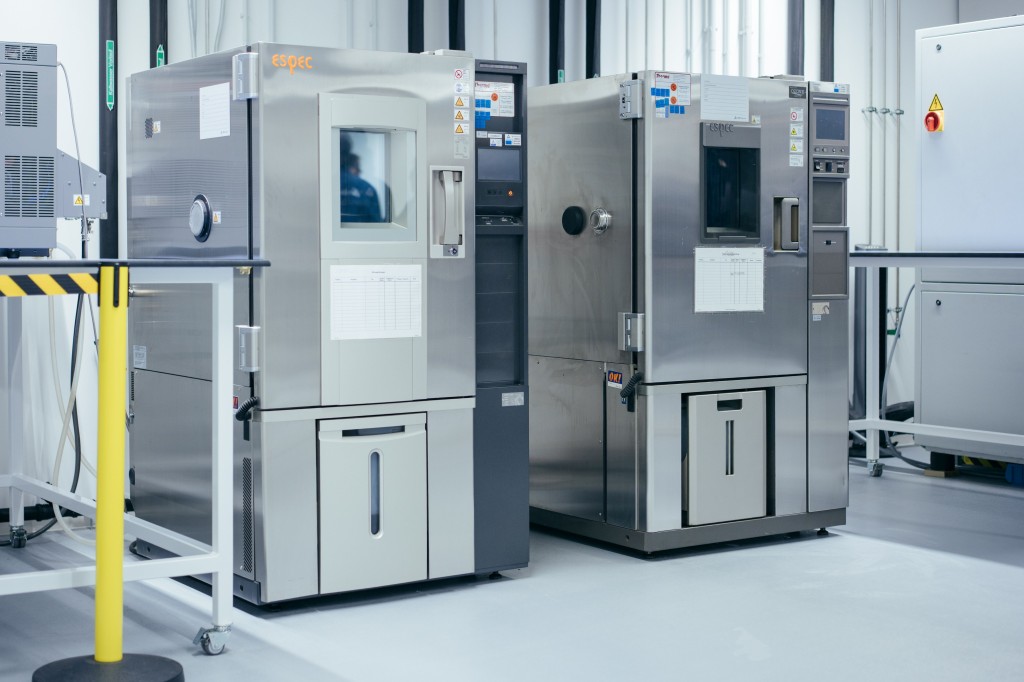
Finally, experts in the environmental simulation laboratory verify whether all these systems can withstand various weather conditions and function reliably. For example, environmental simulation chambers are used to test how a battery storage system reacts to extreme temperature fluctuations.
Building trust in the technologies of tomorrow
It was only at the end of 2025 that TÜV Rheinland invested in a comparable laboratory for high-performance technologies in Milan, Italy—with a stronger focus on automotive applications. Dr.-Ing. Michael Fübi, CEO of TÜV Rheinland AG: “We see a clear trend toward further electrification: More and more electric vehicles are on the roads, while the share of renewable energy from solar and wind is growing. With our new laboratories, we are supporting this development in a targeted and reliable manner. We are investing here in Germany to be close to our customers and thus better support them. Our goal is clear: We want to be pioneers of an electrified future. I am particularly pleased that an important cornerstone for this path has been established here in Troisdorf, so close to our corporate headquarters.”
Roman Brück, Head of the Power Test Center Cologne, adds: “With the Power Test Center Cologne, we are creating optimal conditions for testing high-performance technologies under realistic conditions. In doing so, we help manufacturers bring their products to market faster while also contributing to a high-performance, safe, and sustainable energy infrastructure.”
Your contact for editorial inquiries:
TÜV Rheinland Press Office
Do you have any questions on this topic or need further information?
Please do not hesitate to contact us:
Phone: +49 221 806-2148